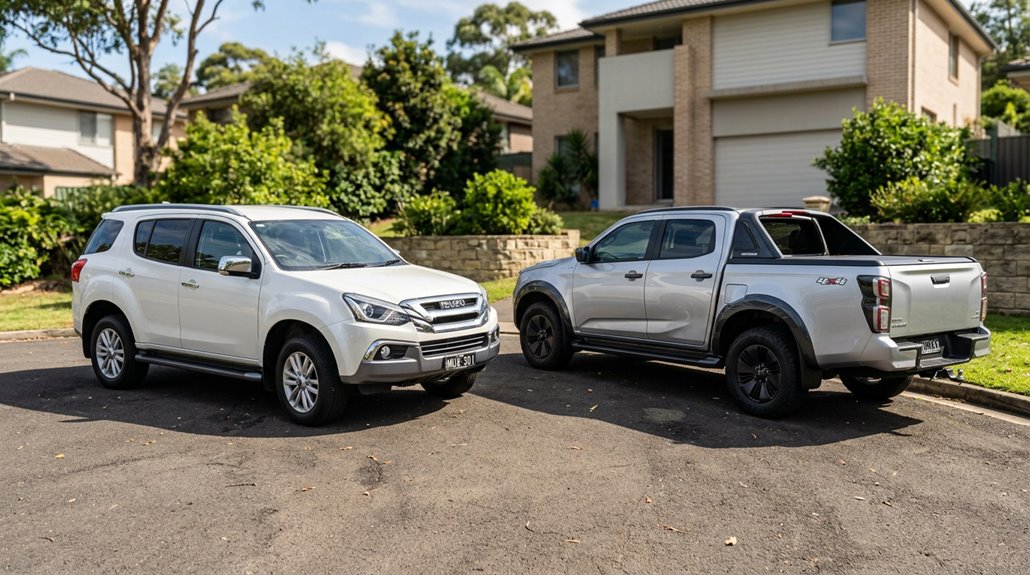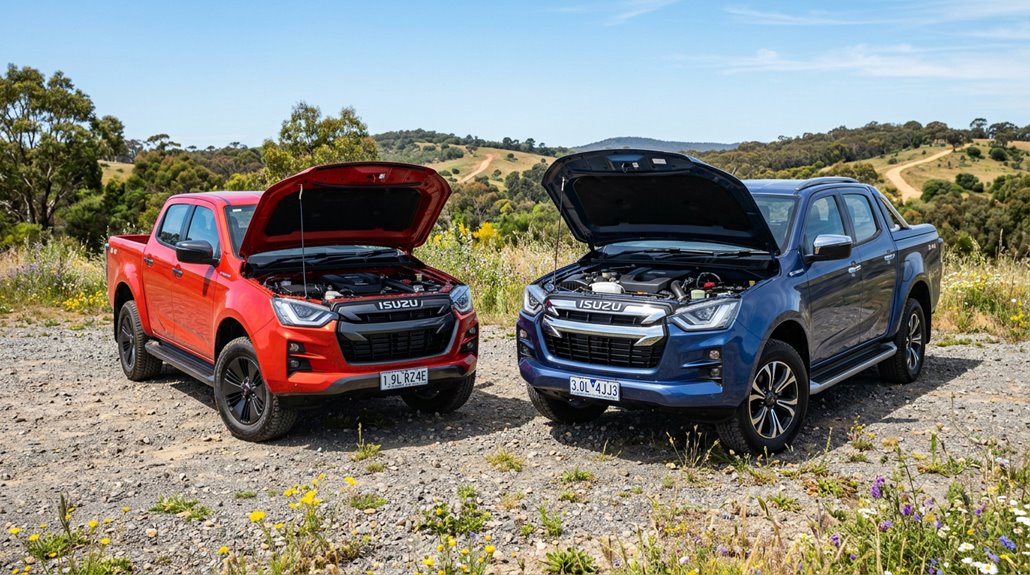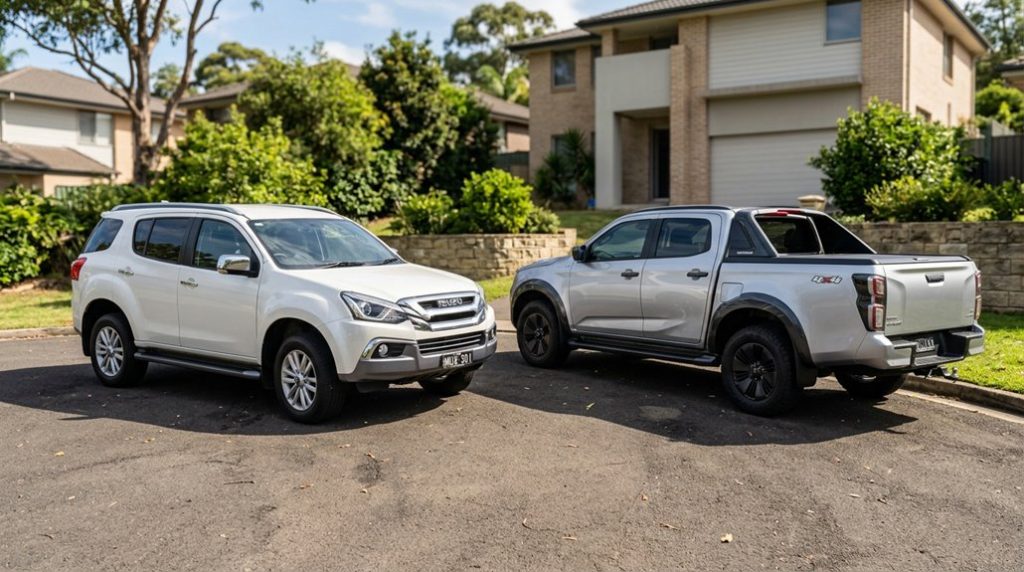
Most people assume a bigger price tag means a better vehicle — but what if the £12,000 difference between the Isuzu MU-X and D-Max actually tells a completely different story? One hauls your entire family in seven-seat comfort with cavernous cargo space; the other muscles through demanding work sites with serious payload capability. These two Isuzu siblings couldn’t be more different, yet choosing the wrong one could cost you far more than money. The real question is which lifestyle you’re actually living.
Seven Seats vs. Five Seats: Why Passenger Capacity Matters for Your Family
When evaluating family vehicles, passenger capacity emerges as a fundamental consideration that shapes daily logistics and long-term flexibility. The manual_isuzu mux accommodates seven occupants across three rows (2-3-2 configuration), whilst the mux dmax delivers five seats in two rows. This distinction proves decisive for households with multiple children or those frequently transporting relatives and guests.
The seven-seat layout distributes passengers across dedicated rows, reducing crowding and enabling strategic separation between children. Families can allocate different age groups to appropriate positions, simplifying supervision during trips. The additional row accommodates grandparents, visiting cousins, or school car-pool arrangements without reconfiguring existing child seats. Auto House Vryheid offers a range of finance and insurance options to help families secure the MU-X within their budget.
Conversely, the Isuzu D-Max’s five-seat configuration prioritises crew utility and tray capacity, suiting households with one or two children. However, this arrangement concentrates rear passengers on a single bench, limiting flexibility as family size grows or visiting relatives require transport. Understanding that request blocking can occur when systems become overloaded helps families appreciate the importance of having adequate space rather than experiencing cramped conditions.
Ride Quality and Cabin Refinement: Which Vehicle Wins Long-Distance Comfort?
Beyond passenger capacity and practicality, the comfort experienced during extended voyages separates vehicles designed for family touring from those engineered primarily for utility. The MU-X employs a multi-link coil-spring rear suspension that prioritises passenger compliance over load capacity, providing superior bump absorption on Northern KwaZulu-Natal’s mixed-quality highways. The D-Max utilises leaf-spring rear suspension, which strengthens payload stability but produces a firmer, more jittery unladen ride typical of utility vehicles.
MU-X cabins feature improved sound-deadening materials and insulation, reducing tyre roar and drumming at cruising speeds. The D-Max’s open tray configuration permits greater cabin noise than the MU-X’s enclosed wagon body. The MU-X’s soft suspension setup delivers a plush ride quality that remains comfortable up to highway speeds, though small bumps become more noticeable at higher velocities. For families managing this Isuzu bakkie comparison whilst considering options to buy Isuzu D-Max or MU-X, Auto House Vryheid recommends prioritising ride polishing alongside seating capacity for extended trips. To maintain either vehicle’s comfort and handling characteristics over time, scheduled maintenance services performed by certified technicians using genuine Isuzu parts ensure suspension components and related systems continue performing at their best.
Budget Reality: Understanding the True Cost Difference Between Models
Comfort considerations form only one aspect of the family vehicle equation; financial reality demands equally careful scrutiny. The D-Max entry-level model begins at approximately $36,990 drive-away, whilst the MU-X base variant starts at $48,990 drive-away—a $12,000 differential that warrants consideration. Premium configurations maintain similar gaps: the top-spec D-Max 4×4 X-Rider Crew reaches $56,990 drive-away against the MU-X 4×4 LS-T at $69,990 drive-away.
Engine selection markedly influences pricing. The 2.2L variants command lower prices than 3.0L counterparts across both models. Drive-away offers reduce effective purchase costs markedly, with selected MU-X grades available below listed prices. Annual servicing costs approximately $469 per visit for the first five years, representing a significant running-cost consideration alongside fuel economy improvements. Both vehicles include six-year, 150,000km warranty coverage as standard. Tailored financing options with manageable payments and favourable terms can bridge the gap between these two models, making either vehicle accessible regardless of budget constraints. For Northern KwaZulu-Natal families, this pricing structure permits informed budget alignment with genuine requirements rather than aspirational preferences.
Work, Recreation, and Urban Living: Matching the Vehicle to Your Real-World Routine
The choice between the MU-X and D-Max extends beyond budget considerations into how each vehicle aligns with daily routines spanning work commitments, recreational pursuits, and urban routing.
The D-Max’s compact dual-cab footprint and open tray configuration suit tight city parking and frequent cargo loading, whilst the MU-X’s larger SUV body presents manoeuvrability constraints in congested urban environments but excels when transporting passengers and recreational equipment simultaneously. The 2.2 L engine in the D-Max delivers improved towing capability over its predecessor, increasing brake towing capacity to 3.5 tonnes, which matters for those frequently hauling trailers or equipment.
Grasping these practical distinctions—particularly payload capacity, seating flexibility, and spatial demands—determines which Isuzu best serves the actual demands of Northern KwaZulu-Natal living. Auto House Vryheid further supports ownership confidence through finance and insurance services, ensuring buyers can secure and maintain their chosen vehicle with structured financial solutions.
Urban Manoeuvrability and Parking
How does vehicle size influence your daily experience manoeuvring Vryheid’s streets, parking areas, and shopping precincts? The MU-X delivers measurable advantages for urban navigation. Its shorter overall length reduces rear overhang, simplifying parallel and angle parking in confined bays throughout local shopping centres. The wagon-style body keeps the footprint closer to large-SUV dimensions rather than extending to full pickup proportions.
The MU-X’s independent front suspension and chassis tuning prioritise family duty cycles, delivering responsive steering at low speeds and predictable body control during three-point turns. A shared wheelbase with the D-Max, combined with reduced rear overhang, creates a more manageable turning path through multilevel car parks and suburban cul-de-sacs. The integrated reverse view camera assists with spatial awareness when executing tight manoeuvres in confined urban environments.
The D-Max’s tray-back design extends notably behind the rear axle, requiring greater spatial awareness when navigating cramped driveways and laneway garages typical of Northern KwaZulu-Natal residential areas.
Cargo Flexibility For Work And Play
Beyond the suburbs of Vryheid, where family obligations intersect with occasional work demands, cargo capacity becomes a genuine determinant of vehicle suitability.
The MU-X provides 311 litres with all seats upright, expanding to 2138 litres with rows folded flat. This enclosed bay protects electronics, documents, and groceries from dust and weather exposure—a considerable advantage for professional families managing both household and light work gear simultaneously.
The D-Max dual-cab tray offers approximately 1570 mm length and 1530 mm width, accommodating pallets, timber, and bulky materials. Its open design suits landscaping supplies and machinery transport, though exposed cargo requires weather protection.
For households balancing school runs, weekend recreation, and occasional trade work, the MU-X’s flexible seven-seat configuration and weather-proof storage deliver superior versatility. The D-Max prioritises payload capacity (approximately 1000–1200 kg versus MU-X’s 665 kg), favouring dedicated work applications over mixed family use.
How Your Isuzu Dealership Can Help You Navigate the Decision
A dealership specialising in both the MU-X and D-Max can provide structured guidance through specification sheets, feature comparisons, and detailed walkthroughs of seating layouts, payload capacities, and engine options (ranging from the 1.9-litre 110 kW unit to the 3.0-litre 140 kW variant) customised to your household requirements.
Back-to-back test drives on routes representative of Northern KwaZulu-Natal terrain—urban roads, farm access, and long-distance touring corridors—demonstrate how suspension tuning, noise suppression, and ride quality differ between the MU-X’s three-row comfort focus and the D-Max’s load-oriented characteristics.
Safety feature comparisons, ground clearance assessments (MU-X 230 mm versus D-Max 220 mm), and off-road capability demonstrations enable families to make decisions based on documented performance rather than assumption. Auto House Vryheid’s technicians, with over 100 years of automotive industry experience, can further support your decision by ensuring any vehicle you consider has been thoroughly inspected and maintained to Isuzu’s exacting standards.
Expert Guidance On Specifications
Exploring the technical distinctions between the Isuzu MU-X and D-Max requires more than specification sheet comparisons; it demands interpretation of how engine outputs, seating configurations, and safety systems translate into real-world performance for your family’s specific needs.
Auto House Vryheid’s specialists decode powertrain choices through practical application. The MU-X’s 3.0L turbo-diesel (140 kW, 450 Nm) delivers composed motorway cruising, whilst D-Max options span 1.9L and 3.0L variants, accommodating diverse load requirements across Northern KwaZulu-Natal’s terrain.
| Specification | MU-X | D-Max |
|---|---|---|
| Seating | 7-seat SUV | 5-seat double-cab |
| Length | ~4.85 m | ~5.27 m |
| Ground clearance | ~230 mm | ~220 mm |
| Fuel consumption (3.0L) | ~8.1 L/100 km | ~8.0 L/100 km |
| Cargo capacity | 235 L (seats up) | Open tray |
Dealership consultation clarifies which configuration aligns with family size, parking constraints, and workplace demands.
Test Drive and Comparison Sessions
Specification comparisons provide worthwhile background, yet they cannot replicate the comprehension gained from operating both vehicles across varied road conditions. Back-to-back test drives on dealership-planned routes reveal how the MU-X prioritises passenger comfort whilst the D-Max emphasises payload and towing stability.
Mixed urban and motorway segments reflect typical family usage patterns, exposing differences in ride quality, steering weight, and braking feel. Coarse-chip bitumen surfaces showcase both vehicles’ ladder-frame chassis rigidity and suspension calibration variations.
Sequential drives using identical 3.0L turbo-diesel powertrains isolate body and suspension differences. Inside the cabin, hands-on evaluation of the MU-X’s seven-seat configuration against the D-Max’s dual-cab layout clarifies seating flexibility for larger families. Child-seat trial fitting demonstrates ISOFIX accessibility and door-opening angles across both models.
Ready to Make an Informed Choice?
Both the Isuzu D-Max and MU-X rest upon the same ladder-frame chassis, yet their configurations diverge markedly in purpose and practicality.
The D-Max prioritises payload capacity and work-focused versatility through its open load tray design. The MU-X, conversely, emphasises passenger comfort and family touring through its seven-seat, fully enclosed body.
Suspension tuning reflects these priorities: D-Max suspension favours load-carrying toughness, whilst MU-X tuning balances comfort across rough roads with passengers aboard.
Both vehicles share the same parts and service network, simplifying maintenance logistics regardless of your choice. The MU-X’s 2,845 mm wheelbase dedicates space to cabin accommodation. The D-Max’s 3,095 mm wheelbase prioritises tray length.
For Northern KwaZulu-Natal families seeking reliable, durable transport, either platform delivers proven performance backed by consistent dealer support and straightforward running costs. Both vehicles are also covered by Isuzu warranty protection against manufacturing defects, providing added peace of mind throughout your ownership journey.